
Nothing Proved
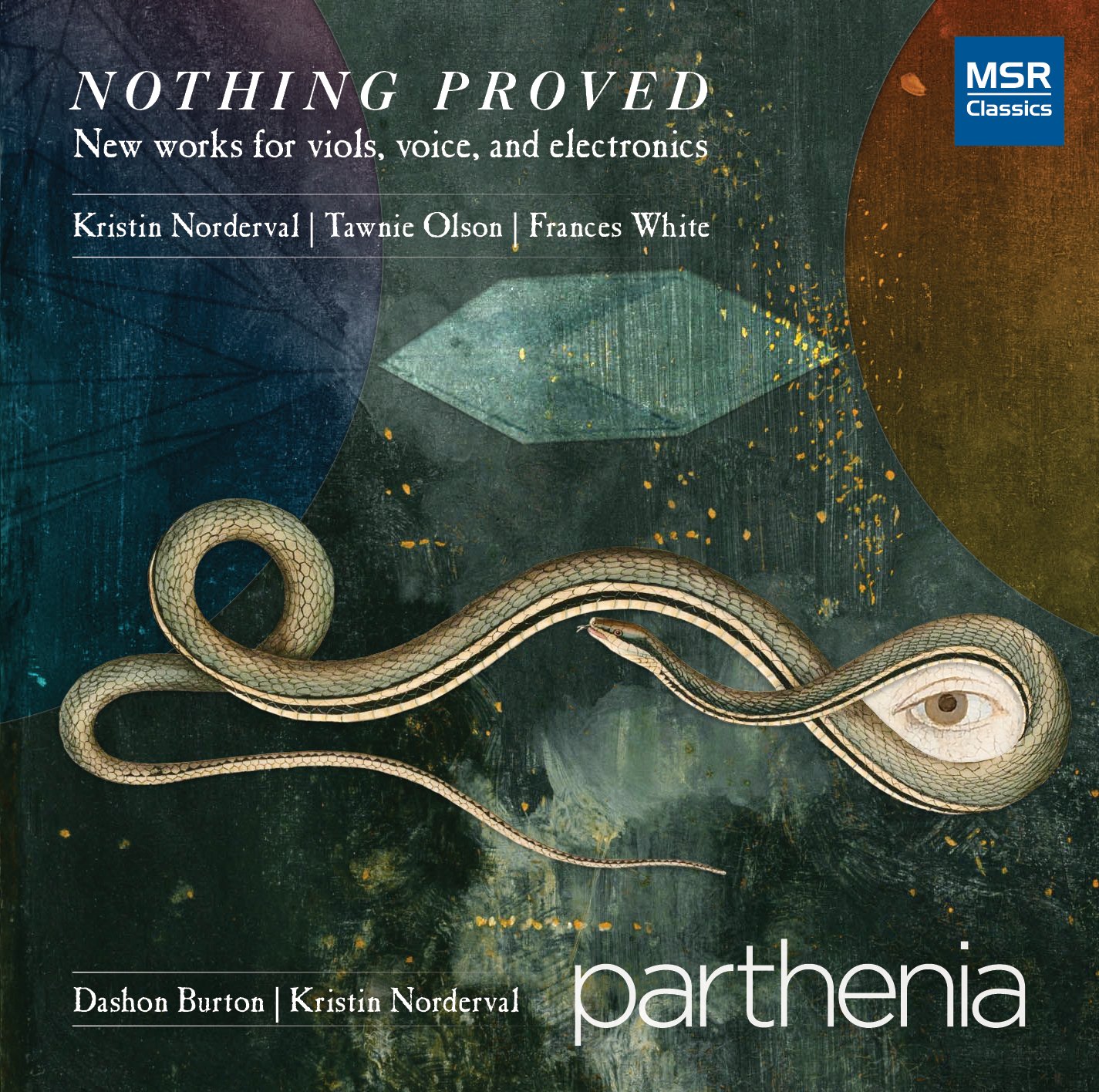
- Release date: 2017
- Label: MSR Classics
- Catalog #: MS 1635
Release Description
New chamber works for renaissance viol consort, all written for and premiered by Parthenia over the past decade, by three outstanding women composers Kristin Norderval, Tawnie Olson, and Frances White. Featured guest artists are bass-baritone Dashon Burton (Room Full of Teeth), soprano Kristin Norderval (Pomerium, Ensemble Pi), and narrator Valeria Vasilevski (NPR, Android Sisters). These compositions create a rich tapestry of stories, ranging from a song cycle for soprano, viols and electronics exploring Elizabethan political intrigue and paranoia through the words of Queen Elizabeth I, to a poignant fairytale about isolation and unexpected friendship between a girl and a bird; from a powerfully resonant depiction of Christ on the cross, to a meditative electronic-enhanced reflection on a chant by abbess Hildegard von Bingen.
Through all four pieces, the medium of the viol consort itself clothes the drama in a kind of period costume. There is a quality of ‘once upon a time-ness’ to the viols’ sound that works well with the story of From a fairy tale, and of course, Nothing proved can be benefits by setting Elizabeth s poetry with Elizabethan instruments. But none of the composers explicitly draw from the historical literature for viols, choosing instead musically to stand solidly in the 21st century, electronics and all. The 21st century is actually a very good place for the viols to flourish again. It is perhaps no coincidence that the viol consort began to wane just as opera began to rise in popularity. The darker, more intimate sound of viols suited music-making in the home, but the future was for the public spectacle of opera, and hence the brighter, louder, edgier sound of the violin. But today, telling stories with music in public can still be an intimate experience. As heard on this disc, there are many ways the sound of the viol consort can be used to tell those stories in a compelling manner. Each composer here takes her own distinctive approach to writing for the instruments, but all were worked out directly from experience with the instruments and with the players of Parthenia. In this collection of old stories told in new voices, these four performers are the other dramatic heroes, bravely commissioning composers to write living repertoire for their ancient instruments. Theirs is not just a token interest in new music, a desire to have a contemporary piece to put on a program for novelty. The Parthenians have a genuine curiosity and an inventiveness about their instruments that allows them to enter directly into the sonic exploration with their composer collaborators.
The Parthenia Viol Consort brings early music into the present with repertoire ancient to freshly commissioned, animated with a ravishing sound and a remarkable sense of ensemble. Parthenia is presented in concerts across the United States, and produces its own series in New York City, collaborating regularly with the world’s foremost early music specialists. The quartet has been featured in prestigious festivals and series as wide-ranging as Music Before 1800, Harriman-Jewell Series, Maverick Concerts, Regensburg Tage Alter Musik, Shalin Lui Performing Arts Center, Pierpont Morgan Library, Metropolitan Museum of Art, Yale Center for British Art, Columbia University’s Miller Theatre and Cathedral of St. John the Divine. Parthenia’s performances range from its popular touring program, When Music and Sweet Poetry Agree, a celebration of Elizabethan poetry and music with actor Paul Hecht, to the complete viol fantasies of Henry Purcell, as well as the complete instrumental works of Robert Parsons, and commissions and premieres of new works annually.
Review
In great part this CD is an attractive and intriguing cross-breeding of ancient and modern (I prefer to think of the human voice as an eternal musical resource and so standing beyond this antithesis). Any who (like me) loves a top-class consort of viols – and is also musically open-minded (which I like to imagine I am) – will surely find Nothing Proven, which is made up entirely of world premiere recordings, a rewarding disc. –MusicWeb International
The works on this album are particularly exciting, as their composers acknowledge the viol’s origins in the Renaissance consort, while exploring new ways of presenting the instrument’s distinct timbre. The most stunning works incorporate electronics… This music is in a class of its own don’t overlook this album. –American Record Guide
The Hildegard of Bingen Alleluia opens this fascinating disc; one of her most famous, we read of Mary symbolized as a branch. It is a fitting way to open a program of women composers of music for viols, bringing the medieval face to face with the modern through the metaphoric link… This is a thought-provoking disc whose conception and execution are of a piece. Luckily, the recording is also excellent; Dashon Burton’s baritone voice is captured as in those fantastic 1960s Decca opera recordings, and I had fun following it as it moved across the sound stage. This is another excellent disc from Parthenia and from the composers who realized the concept’s musical and philosophical potential. –Fanfare
 Kristin Norderval
