
She Lost Her Voice, That’s How We Knew
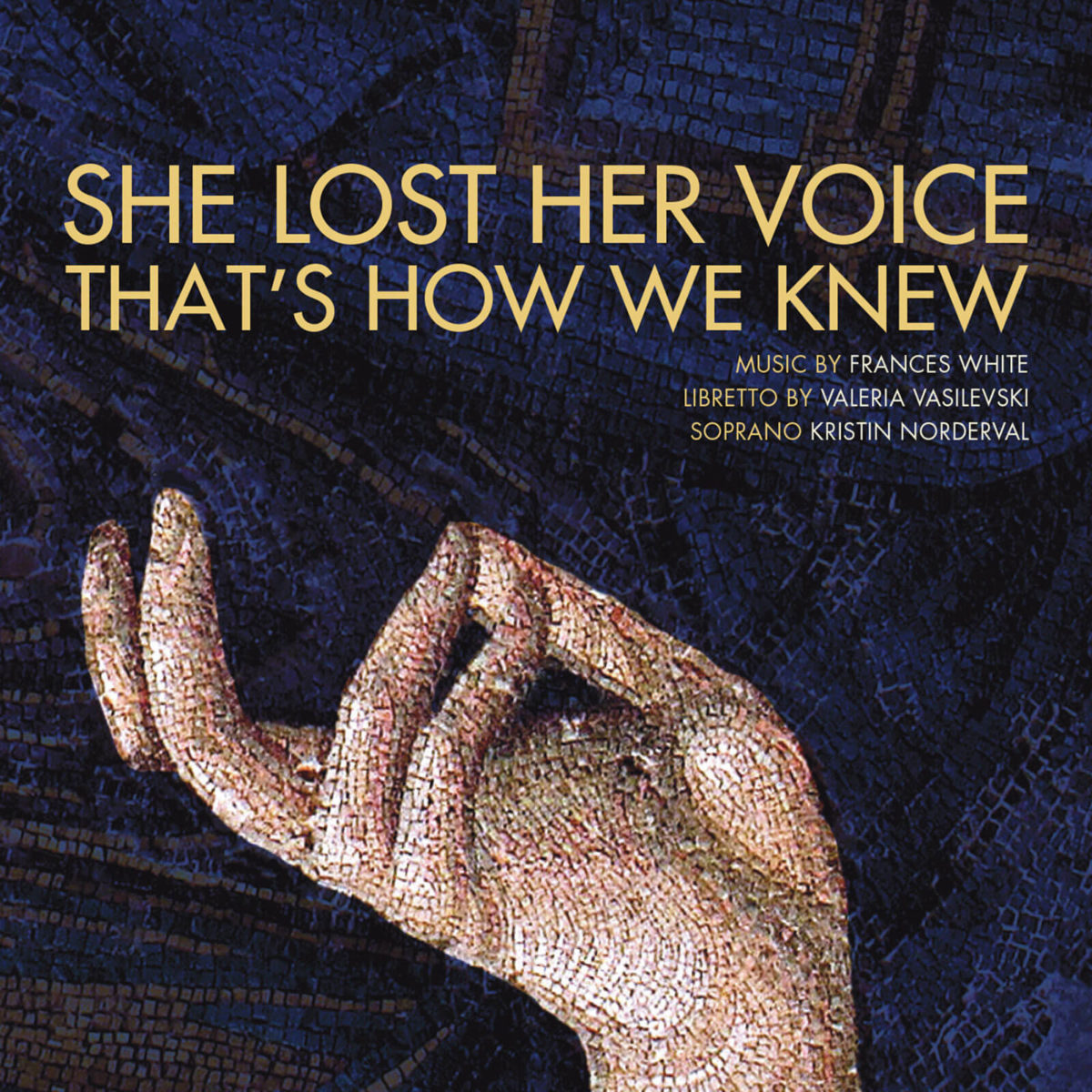
- Release date: 2015
- Label: Ravello Records
- Catalog #: RR 7915
Release Description
The profound events of our lives, including death, birth, trauma, and wonder, often provoke experiences that transcend words, creating moments better suited to the encapsulating depths of silence. Inspired by insights and personal stories, Ravello Records presents the theatrical work for soprano and electronic sound, SHE LOST HER VOICE, THAT’S HOW WE KNEW.
Composed by Frances White, written and directed by Valeria Vasilevski, and performed by vocalist Kristin Norderval, the work is open to the universal issues that are implied by the idea of this loss of voice. Described by WQXR’s Operavore as an “avant-garde diva,” Norderval’s voice provides the fingerprint for the electronic score. The album contains no explicit narrative, rather it offers an interior drama with an emerging persona, which carries many voices: an inner voice, a voice of memory, a singing voice, a silenced voice, and more. This persona is also a listener, hearing the cries of all these different voices.
Review in Music Works
Seductive and hypnotic, this is an utterly convincing work for voice and electronics—not an easy combination. For forty-five minutes, it moves slowly through a text by the piece’s director, Valeria Vasilevski, and blurs genres (chamber opera? theatre work? song cycle?) with its sensual, rhapsodic sound world. Frances White’s music is spectacularly beautiful: soprano Kristin Norderval’s voice blooms through the electronics’ drowned tonality, as the piece explores “the necessity of putting into words experiences that are beyond words, or where words have been suppressed.”
The composer writes, “While there is no explicit, linear narrative, the piece does suggest an interior drama, from which a definite persona emerges. This persona has multiple voices: an inner voice, a voice of memory, a public voice, a private voice, a spoken voice, a singing voice, and a voice silenced by the fears that define our time.” The interweaving of speech and singing, and the imperatives (both sung and spoken), give the text an urgent authority, despite its ecstatic distention.
The piece’s powerful dramatic arc builds from its gleaming, rhapsodic opening to suggest an experience that is deeply unsettling (as hinted at by the title). The program notes describe the staged performance as evocative of Buddhist art and the iconography of the Christian saints, but—and perhaps unexpectedly for a contemporary operatic work—this intimate piece is entirely convincing as a nonvisual listening experience.
With the clarity and elegance (and, in places, the gorgeous vocal polyphony) many listeners will associate with early music, this startling new sound world offers music so atmospheric and sensuous it is almost fragrant.
Cecilia Livingston is a Toronto-based composer and writer.
 Kristin Norderval
